Different Types of Hydraulic Pumps
2026-05-15
Different Types of Hydraulic Pumps
Hydraulic pumps convert mechanical energy into fluid power and are crucial in countless systems across construction, agriculture, marine, and manufacturing industries.
Choosing the right hydraulic pump requires understanding the different types, each designed for a specific application, pressure range, and flow rate requirement.
1. Piston Pumps
Piston pumps are essential components in any high-performance hydraulic pump system. They utilize the reciprocating motion of a piston to generate high pressure and high flow, making them suitable for demanding applications such as heavy construction, mining, and marine propulsion.
Piston pumps are essential components in any high-performance hydraulic pump system. They utilize the reciprocating motion of a piston to generate high pressure and high flow, making them suitable for demanding applications such as heavy construction, mining, and marine propulsion.
These pumps come in both axial and radial configurations, both offering high efficiency and long service life. Axial piston pumps are compact and easy to control, while radial piston pumps are robust and durable, capable of withstanding extreme pressures. Although more expensive, their powerful output and reliability make them indispensable equipment in complex systems.
2. Gear Pumps
Gear pumps are among the simplest and most durable types of hydraulic pumps. They operate by using two meshing gears to transport fluid. There are two common types of gear pumps: external gear pumps and internal gear pumps, which operate on similar principles. This simple mechanical structure makes it inexpensive, easy to maintain, and has fewer moving parts compared to more complex hydraulic pumps.
Gear pumps are among the simplest and most durable types of hydraulic pumps. They operate by using two meshing gears to transport fluid. There are two common types of gear pumps: external gear pumps and internal gear pumps, which operate on similar principles. This simple mechanical structure makes it inexpensive, easy to maintain, and has fewer moving parts compared to more complex hydraulic pumps.
While gear pumps can withstand medium pressures, they are generally not suitable for applications requiring extremely high pressures or precise flow control. However, they are ideal for systems operating under stable conditions. Due to their reliability and durability, gear pumps are widely used in agricultural machinery, vehicle systems, forklift hydraulic systems, and small hydraulic circuits.
3. Vane Pumps
Vane pumps are compact, efficient, and widely used in low- to medium-pressure applications. They work by using rotating vanes to clamp fluid and propel it through the system. As one of the most common pump types in hydraulic systems, vane pumps are generally quieter than other types of pumps and have good volumetric efficiency.
Vane pumps are compact, efficient, and widely used in low- to medium-pressure applications. They work by using rotating vanes to clamp fluid and propel it through the system. As one of the most common pump types in hydraulic systems, vane pumps are generally quieter than other types of pumps and have good volumetric efficiency.
Vane pumps can be divided into constant displacement pumps and variable displacement pumps. Constant displacement pumps provide a constant flow rate, while variable displacement pumps adjust the flow rate according to demand, thereby improving energy efficiency. They are ideal for applications requiring smooth operation, such as mobile equipment and industrial machinery.
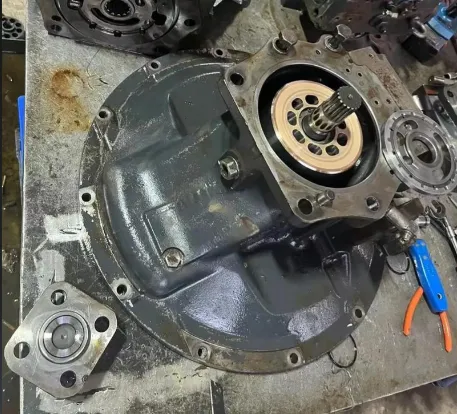
Disassembling a Hydraulic Pump
How to Choose the Right Pump for Your Needs
Choosing the right pump depends entirely on your system requirements. The three most commonly used hydraulic pumps are piston pumps, gear pumps, and vane pumps—each with its unique advantages:
Choosing the right pump depends entirely on your system requirements. The three most commonly used hydraulic pumps are piston pumps, gear pumps, and vane pumps—each with its unique advantages:
Piston pumps offer high pressure, excellent control, and superior efficiency, making them the best choice for complex or heavy-duty systems with demanding performance requirements.
Gear pumps are economical and easy to maintain, ideal for simple systems with stable flow and low control requirements.
Vane pumps operate quietly and smoothly with moderate efficiency, making them ideal for systems that need to maintain stable performance at medium pressures.
Hydraulic Pump Selection Checklist
Use this checklist to help you determine the right pump for your application:
1. What is the maximum operating pressure required?
2. What flow rate is required to meet the system's performance requirements?
3. Is the operation continuous or intermittent?
4. Is the system an open-loop or closed-loop system?
5. How important is the noise level or smoothness of operation?
6. Does the system require variable displacement or advanced controllability?
7. What are your space constraints or installation limitations?
8. What is your initial and long-term maintenance budget? Understanding these core requirements will help narrow down the range of pump types and configurations needed for your hydraulic system.
With a wide variety of hydraulic pumps available, choosing the right model can be challenging. Sino Hydraulics offers a wide range of piston pumps and serviceable hydraulic components to meet diverse application needs. You can contact us directly for expert assistance and technical support. Our team is ready to guide you through every step of the selection process.
Hydraulic Motor Glossary
Mechanical Systems and Hydraulic Systems