Is a hydraulic pump a constant displacement pump or a variable displacement pump
2026-05-25
Is a hydraulic pump a constant displacement pump or a variable displacement pump?
A hydraulic pump is the driving force of a hydraulic system, converting mechanical energy into pressurized fluid motion. These pumps ensure smooth operation in industries such as construction, manufacturing, and aerospace.
Hydraulic pumps can be divided into constant displacement pumps and variable displacement pumps. A hydraulic pump cannot simultaneously possess both constant and variable displacement characteristics, but some models can be modified to achieve conversion or switching between the two modes.
Understanding the differences between these two types of pumps is crucial when designing or maintaining hydraulic systems. Choosing the right pump can significantly impact energy efficiency, performance, and system lifespan. Let's explore how these pumps work, compare their advantages and limitations, and help you determine which option best suits your needs.
What is a constant displacement hydraulic pump?
Variable displacement hydraulic pumps: A constant displacement pump delivers a constant amount of fluid with each rotation of its input shaft, providing a stable flow rate regardless of system demands. This makes it ideal for applications requiring a continuous supply of pressurized fluid. These pumps are widely used in industrial and mobile hydraulic systems where reliability and ease of use are paramount.
Types of Constant Displacement Pumps
Several types of constant displacement pumps are commonly used in various applications:
Gear Pumps – Gear pumps are one of the most common types of constant displacement pumps. They use meshing gears to transport fluid. Gear pumps are economical, efficient, and durable, making them ideal for low to medium pressure applications.
Vanilla Pumps – These pumps use rotating vanes within a cam ring to generate fluid motion. While typically used in medium pressure applications, they offer a smoother flow rate compared to gear pumps.
Constant Displacement Axial Piston Pumps – These pumps have a circular piston arrangement, enabling efficient, high-pressure fluid transport through the system.
Advantages of Constant Displacement Pumps
1. Simple and Reliable Structure – These pumps require less maintenance due to fewer moving parts.
2. Lower Cost – More economical than variable displacement pumps.
3. Suitable for Continuous Operation – Can be used in open circulation systems requiring a constant flow rate.
Limitations of Constant Displacement Pumps
1. Inefficient in Variable Load Systems – Because the flow rate remains constant, excess fluid must be redistributed, resulting in energy waste.
2. Poor flexibility – Unable to adapt to constantly changing flow requirements, therefore unsuitable for applications with varying operating speeds.
3. Fixed displacement pumps are commonly used in material handling equipment and hydraulic presses, where stable operation is more important than adjustability.
What is a variable displacement hydraulic pump?
Variable displacement pumps can adjust the fluid delivery rate per cycle, thereby improving efficiency in applications with varying flow requirements. These pumps utilize internal mechanisms such as pressure compensators to dynamically change the displacement.
How Variable Displacement Pumps Work
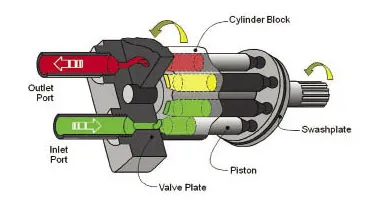
Variable displacement pumps control flow by adjusting internal components such as swashplates, cam rings, or radial pistons. These pumps offer greater efficiency and adaptability in hydraulic systems with constantly changing flow requirements. The most common types include:
Variable displacement pumps control flow by adjusting internal components such as swashplates, cam rings, or radial pistons. These pumps offer greater efficiency and adaptability in hydraulic systems with constantly changing flow requirements. The most common types include:
Axial piston pumps – These pumps use an adjustable swashplate to control the piston stroke length, thereby changing the fluid delivery rate per cycle. They are widely used in aircraft systems and mobile hydraulic equipment.
Radial piston pumps – In these pumps, the pistons are arranged radially around a central cam, and the displacement is adjusted by changing the cam's eccentricity. Radial piston pumps offer high-pressure output, making them ideal for hydraulic presses and high-load applications.
Variable displacement vane pumps—achieve precise flow control by adjusting fluid flow through a moving cam ring. They are known for their smooth operation and low noise, and are commonly used in machine tools, injection molding machines, and automotive testing systems.
Each variable displacement pump is designed to optimize energy efficiency, reduce heat generation, and provide precise hydraulic oil control according to system requirements.
Advantages of Variable Displacement Pumps:
1. Energy Efficiency – Adjusts flow according to demand, reducing energy waste.
1. Energy Efficiency – Adjusts flow according to demand, reducing energy waste.
2. Lower Heat Generation – Reduces unnecessary fluid flow, thus reducing heat buildup.
3. Optimized for Variable Loads – Suitable for closed-loop and open-loop systems with frequently changing flow requirements.
Limitations of Variable Displacement Pumps:
1. Higher Complexity – Requires precise calibration and maintenance.
1. Higher Complexity – Requires precise calibration and maintenance.
2. Higher Cost – More expensive than fixed displacement pumps.
3. Variable displacement pumps are ideal for applications with high efficiency and adaptability requirements, such as engineering machinery, aircraft hydraulic systems, and industrial automation.
Differences Between Constant Displacement and Variable Displacement Pumps
When choosing between constant displacement and variable displacement hydraulic pumps, it's essential to understand their fundamental differences. Here's a comparison of their main characteristics:
Constant Displacement Pumps
1. Constant output per revolution.
2. Wastes excess energy.
3. Generates more heat due to the need for pressure compensation for excess flow returning to the tank.
4. Simpler and lower cost.
5. Ideal for continuous, high-pressure tasks.
Variable Displacement Pumps
1. Adjustable to demand.
2. Higher efficiency, reduces excess flow.
3. Less heat generation, thus reducing cooling requirements.
4. More complex and more expensive.
5. Ideal for applications where application speed requirements vary.
1. Constant output per revolution.
2. Wastes excess energy.
3. Generates more heat due to the need for pressure compensation for excess flow returning to the tank.
4. Simpler and lower cost.
5. Ideal for continuous, high-pressure tasks.
Variable Displacement Pumps
1. Adjustable to demand.
2. Higher efficiency, reduces excess flow.
3. Less heat generation, thus reducing cooling requirements.
4. More complex and more expensive.
5. Ideal for applications where application speed requirements vary.
How to Choose Between Constant and Variable Displacement Pumps
Variable Displacement Pumps
Choosing the right hydraulic pump depends on several factors. Key considerations include:
Variable Displacement Pumps
Choosing the right hydraulic pump depends on several factors. Key considerations include:
1. System Requirements
If your hydraulic system operates with a stable flow rate, a constant displacement pump may be the best choice.
If your system load changes constantly and requires dynamic adaptation, a variable displacement pump will improve efficiency.
If your hydraulic system operates with a stable flow rate, a constant displacement pump may be the best choice.
If your system load changes constantly and requires dynamic adaptation, a variable displacement pump will improve efficiency.
2. Energy Efficiency
Variable displacement pumps are a better choice for systems where energy saving and reducing heat buildup are priorities.
Constant displacement pumps offer reliability for simple devices with low maintenance costs where energy consumption is not a primary concern.
3. Application Types
Industrial presses, lubrication systems, and hydraulic lifts all benefit from constant displacement pumps.
Industrial presses, lubrication systems, and hydraulic lifts all benefit from constant displacement pumps.
Construction machinery, aircraft hydraulic systems, and mobile hydraulic systems all require variable displacement pumps for improved efficiency and adaptability.
4. Cost and Maintenance
Constant displacement pumps have lower upfront costs and are easier to maintain, making them ideal for applications with limited budgets.
Constant displacement pumps have lower upfront costs and are easier to maintain, making them ideal for applications with limited budgets.
Variable displacement pumps can achieve long-term energy savings, but require compensator settings and pressure control for optimal operation.
Hydraulic Pump Spare Parts from Sino Hydraulics
Sino Hydraulics offers a complete range of high-quality hydraulic pumps and repair parts to meet your various needs. We provide professional consulting services, competitive pricing, and a large inventory. With our deep industry experience and unwavering commitment to quality, we help businesses across all industries—from construction to manufacturing—find the right fluid power solutions for their applications.
How to Repair Hydraulic System Jerking Issues
Hydraulic Motor Glossary